
READING MIŁOSZ READING RODZIEWICZÓWNA
Some remarks on Czesław Miłosz's essay on Rodziewiczówna
1/1/202614 min read
by Tom Pinch
When Czesław Miłosz returned to Poland in 1990, he was told—almost in a whisper, as if one were confessing a shameful habit—that the safest way for a publishing house to make money was to print Maria Rodziewiczówna. The confession embarrassed the educated classes. It embarrassed him, too, but it also fascinated him. How could a nineteenth-century writer, rejected by literary critics and dismissed as sentimental kitsch, still command such loyalty from readers born into a world of television and postmodern irony?
So Miłosz did something both perverse and honest: he started rereading Rodziewiczówna, one novel after another, and discovered that he was now reading her with two pairs of eyes. One belonged to the schoolboy he once was, borrowing these books from his grandmother and devouring them without reflection. The other belonged to a skeptical modern intellectual. The shock lay in the gap between the two.
1
Trying to understand Rodziewiczówna’s success, Miłosz discovered, to his surprise, a number of virtues in her novels. The enduring popularity of Rodziewiczówna was not mysterious at all. He listed several.
The narrative technique
First and foremost, he says, she is a superb storyteller: she knows how to tell a gripping story. Her novels use every traditional and effective device modern critics despise: blunt moral labeling of characters, melodramatic turns, omniscient entry into every head, suspense that leaves you worrying about the fate of people you’ve just met. Strip literature of these “primitive” devices, he notes, and you get books admired by specialists but unread by ordinary people.
Protagonists
He then turns attention to the protagonists of her novels. He notes that they are generally old-fashioned goody-two-shoes. Her women are saints or martyrs. They are virtue incarnate, unhesitating in their moral instincts. If they err, they pay with their lives. A young woman converted to atheism is raped and poisons herself; another marries without love and dies of typhus when her deported fiancé returns and rejects her; a prostitute redeems herself through absolute devotion to her illegitimate child. Her men are equally heroic: strong, handsome, capable of almost superhuman feats in fires, floods, and hunts.
Not for Rodziewiczówna the modern inventions of unreliable narrators (Lolita), or antiheroes (Red and Black, Bel Ami, The Executioner’s Song), or weak, bland characters of the Hans Castorp sort. This blatant didacticism may repel scholars, but it does not repel readers, Miłosz notes; on the contrary, it reassures them. By identifying with these ideal figures, readers feel themselves part of a moral community in which good and evil are obvious and shared. (Indeed, morally upright protagonists are behind the undying success of many Victorian novels).
The aspirational struggle
Finally, Miłosz notes, Rodziewiczówna’s heroes interest us because they are endowed with a strong will, and this will, in accordance with the author’s didactic intention, is directed toward the accomplishment of some important and difficult good. Obstacles appear, those obstacles are grappled with, and victories and defeats make up the main thrust of the plot. It would be somewhat risky to claim that where there is no will, there is never an interesting narrative, yet the passive human being of the modern novel, directionless and fragmented into crumbs of sensations, bears a large share of responsibility for the meagreness of the plot in the contemporary novel.
But the great struggle at the center of each of Rodziewiczówna’s novels is not just a plot device; it transforms the reader’s vision of the world; it immerses him or her in the vision of the world as a place where heroic deeds are performed by everyday people in everyday life. It allows the reader to reimagine himself as a hero of his own life, fighting his own heroic battles. If saving an indebted farm from ruin, or a nineteenth-century woman completing university education despite all family, customary, and administrative obstacles, can be the topic of a gripping novel, then our own economic and emotional struggles take on an aspect of the heroic. Such novels make us see ourselves as the great heroes of our own lives, far better than any abstract tale of fantasy or science fiction can.
Given all this, Miłosz wonders why Rodziewiczówna has not attained a place in the pantheon of Polish literature akin to that of Orzeszkowa, a writer whose traditional, nineteenth-century novels use the same plot devices to tell tales of the same sort of morally upright characters grappling with the same moral challenges of everyday life, in the same geographical setting. His answer shows a lack of sustained intellectual investment in understanding the issue:
Perhaps, however, Rodziewiczówna was renounced for the honor of the house; how so? Is Polish literature really suffering from such a shortage of novels that it must be represented by a handful of women?[1]
Miłosz is not wrong. The reason for rejecting Rodziewiczówna is wholly conventional and indeed has to do with who she was, but the cause of the objection was not her sex; it was her sexuality.
2
As a great lover of literature, but not its practitioner—a reader rather than a writer—I am surprised to see one aspect of Rodziewiczówna’s novels entirely missing from Miłosz’s analysis. Given that he was a poet; one capable of great lyrical beauty; and clearly sensitive to it in the writings of others; I find it notable that he makes no mention at all of Rodziewiczówna’s literary style. And yet, for me, it is one of the principal joys of her writing.
In part, of course, that joy comes from certain exotic elements of her prose: she comes from the East, a region far away from modernity and one full of other ethnicities. As a result, she uses archaisms and regionalisms which a Polish reader accustomed to the modern diction of central Poland must perforce find charming and which present a particular challenge to the translator.
But there is far more to her writing than diction. Her ability to evoke powerful impressions of distant places or elevated emotional states with a great economy of words is quite exceptional. Her descriptions of the Kazakh steppe or of the spring thaw on the Tobol in her An Expendable Soul; or of the wild, magical, otherworldly waterworld of the Pinsk marshes in Chahary and From the Depths; are accomplished with just three or four sentences and yet evoke in the reader an extraordinary, powerful sense of being there.
Or take this, from A Summer of the Forest Folk:
But at last, Wolverine grew drowsy from exhaustion. He still watched as the smoke of his fire wafted towards the mists and mingled with them; he heard the warning croaking of a mother mallard; and then he also wafted away, joining the smoke and the mists.
And he was now as light as them. Day came, and he floated over the meltwater, looked into nests, stroked birds with his hand, swam in the river, wrapped his arm around the moose’s neck, watched, standing one step away, how a recluse bittern sank his beak into the slime and buzzed loudly, and with his fist knocked away the eagle owl from a piebald deer foal.
And with this magical dream ended the busy day of Chief Wolverine.[2]
Rodziewiczówna is also a great master of the metaphorical image, such as this scene from A Summer of the Forest Folk, in which the protagonist’s heroic act receives its figurative glorification. Whatisit, gravely wounded, is taking weeks to recover. He passes in and out of sleep in the garden.
And when he woke up, the day had leaned towards evening. Odrowąż emerged from the forest, and out of the folds of his coat, he poured a pile of yellow chanterelles and ruddy flirts at his side.[3]
The awe of a beautiful literary phrase or image, often attended by the sensation of being transported to other places and other times, is one of the most powerful pleasures of reading, and I never cease to wonder how not only theorists of literature, but also its authors forget about this fundamental fact. One must ask himself: do they know what they are doing?
3
And while he entirely misses—or perhaps only ignores?—the beauty of her prose, Miłosz makes up for this failure by doing what every professor of literature these days must: he devotes much attention to the politics of Rodziewiczówna’s novels.
To his credit, he does not read these novels to produce the usual political diatribe against the usual suspects—post-colonial, orientalist, subaltern, and such—the sort of vices professors build their careers upon. Rather, he reads them as a memoir. Not because Rodziewiczówna wrote autobiographically, but because she recorded—often unconsciously—entire mental universes now vanished. In no other Polish novelist does Miłosz find so many concrete details of the eastern borderlands of the former Commonwealth at the end of the nineteenth century: the relations between gentry, the free and the servile peasants, the ways estates were ruined, the anxieties about dowries, wills, forged bills of exchange, the paralysis of an economy with no industry and almost no credit.
What hurts Miłosz as he reads is how inseparable all this is from what he knows came later. Deportations, gulags, the extermination of Jews and of the Polish gentry, the disappearance of entire regions from the map. To Miłosz, reading Rodziewiczówna is like reading a family chronicle of relatives who were later crippled, dispersed, annihilated.
Rodziewiczówna’s world is economically frozen. Land is the only capital. Industry does not exist. Money belongs to “outsiders.” To survive, one must farm well or fall into ruin. Careers are possible only far away, deep in Russia, and only if one does the unthinkable and collaborates with the enemy. Those who stay accept humiliating posts as estate officials. Women wait for husbands because professions are almost unattainable. Hence the obsession with dowries, marriages, inheritance.
Miłosz then enters the most disturbing territory: the ethnic relations of the time and place and Rodziewiczówna’s system of oppositions between “us” and “them.” In the Pinsk marshes, Belarusian peasants speak a different language and profess a different faith, yet they are not “foreign.” They are children to be morally raised: they are a rough building material from which education and economic growth may yet make proper Poles. Jews, however, are the absolute Other. Their domain is money, and money is inherently filthy in a feudal order built on land. Jews cheat, spy, blackmail, traffic in forged documents, serve vodka in taverns where secrets are extracted. Germans conspire with the Russian administration, falsify documents, manipulate banking laws, regulations, and court procedures to cheat the locals of their inheritance and livelihood. The protagonists of the novels often see beating a Jew or a German, or burning down his tavern, sometimes with him inside, not as a crime but as a catharsis. In Rodziewiczówna’s universe, the word “antisemitism” or anti-germanism would be incomprehensible; hatred of Jews and Germans is identical with hatred of evil itself.
Miłosz is of the World War Two generation, and hostility to German settlers does not bother him too much. But he notes and refuses to excuse the antisemitism. He tries to understand it historically. In a world where every financial transaction feels like moral contamination, he says, the middleman inevitably becomes a demon. He reminds us that this picture stood in brutal contrast to the real Jewish world of Belarus and Ukraine—religious debates, Haskalah, Yiddish and Hebrew literature, a culture crushed between poverty and tsarist oppression, producing later the intellectual giants of Russian and Western culture.
He does not, however, note that the hostility was unbridgeable because it was mutual. In the novels of Isaac Bashevis Singer, which describe life in the same places in the same era, Gentiles are either entirely absent or, as in Wanda, they appear filthy, bestial, sadistic, or mentally retarded. The terrifying upshot of this mutual hostility was that the lands Rodziewiczówna described were soon wiped clean of both Jews and Polish gentry. Their world—her world-simply ceased to exist.
4
In this context, Miłosz discusses the problem of Rodziewiczówna’s homeland. Her heroes fight and die for a fatherland stretching “from Kraków to Smolensk.” But in the Pinsk marshes, the Polish-speaking gentry were a tiny minority among Orthodox peasants who often assisted Russian authorities against the Polish insurgents. Where, then, was the real homeland of these patriots? Were they colonists in their own land? Or were they descendants of locals who centuries earlier changed language and faith from Belarusian to Polish? The paradox is troubling, yet Rodziewiczówna’s characters never question it. Their identity is centered on Kraków, where the royal tombs lie; their periphery is the “borderlands” where they live and which they defend as outposts of Poland.
Miłosz recalls his own childhood reading A Summer of the Forest Folk, a book full of ornithology and scouting virtues, and notes with surprise how its social structure mirrors all her other novels: summer vacationers in the forest come from Warsaw and are anchored in a neighboring manor of Polish gentry, Belorusian peasants appear only as patients or superstitious primitives. Even here, the political program emerges in the burial of a 1863 insurgent, accompanied by hymns and rhetoric of national resurrection. But his memory fails him. The summer visitors and the local manor do maintain friendly relations with local peasants, except not with the Belorusians. Odrowąż and his family are Polish peasants, living in a Polish enclave surrounded by a sea of Belarusians.
From the Pinsk marshes, Miłosz then moves north to Samogitia, a region of Lithuania, where he was born and raised. Why does Devaytis, with its symbolic sacred oak, take place not in ethnically pure central Poland, but in Samogitia? Why is this region the archetypal nest, the cradle of ancient Polish virtues? Here, he senses the power of a myth: Lithuania is the motherland of Polish chivalric values. Devaytis may be a clumsy novel, perhaps even plagiarized, but its oak—named with a Lithuanian word for God—becomes a pagan relic sanctifying Polish patriotism.
And this is hardly surprising. Lithuania was the birthplace of Polish romanticism and therefore of modern Polish literature. That the greatest Polish literary classics come from authors born in Lithuania is a fascinating paradox, as if Goethe and Schiller came from Prague, or Dante and Petrarch had been born and raised in Trieste or Crete.
But Rodziewiczówna knows more about Lithuanian matters than any of her Polish contemporaries. In Szary proch she depicts the clandestine movement of book smugglers who carried Lithuanian publications across the Prussian border after printing in Latin script was banned by the Russian regime. Millions of books were smuggled. And thus, out of philology, a nation was reborn. Yet her readers saw only brave villagers defying the Russian oppressor. The thought that Lithuanian might be a full-fledged literary language would have seemed quaint and amusing.
Here Miłosz inserts his own biography: growing up near Kiejdany, living in a bilingual world, watching how Polishness and Lithuanianess intertwined, clashed, humiliated one another. He recalls the embarrassment described by Vincas Kudirka, the future author of the Lithuanian anthem, who, as a gymnasium student, hid his Lithuanian father and strove to speak Polish badly rather than Lithuanian well. In Rodziewiczówna, this drama is half-visible if you only read her carefully.
Her own idea of Poland drifted toward National Democracy, the party that identified the old Commonwealth, with its pre 1772-borders, with Poland, and saw the eastern question as a matter of borders with Russia alone. Yet her own imagination remains older, more tribal. Her heroes call themselves “we Lithuanians” and despise koroniarze (people from the Polish Crown lands—Warsaw, Krakow). Warsaw becomes the city of corruption, spiritual emptiness, and hypocrisy, a place where only outsiders—often from Lithuania or from the Pinsk marshes—can act morally.
And then Miłosz notices something telling: when a character sings a Lithuanian patriotic song, readers find it charming. If he sang in German, Yiddish, or Ukrainian, the reaction would be entirely different. Lithuanian identity, in the Polish stereotype, is not threatening; it is decorative.
In the end, Miłosz reads Rodziewiczówna not so much as literature but as a document, as a fossilized mental landscape, preserving stereotypes, loyalties, cruelties, and blind spots with the precision of a diary written without self-censorship. Her popularity, he suggests, means that a certain ethos has not died. Beneath modern language, it still breathes, ready to be revived whenever people long for a moral world without ambiguity. To read her today is therefore both illuminating and painful. It is like opening a family album after the family has been annihilated.
5
Like most commentators on Rodziewiczówna’s place in the national canon, Miłosz, writing in 1992, missed the elephant in the room: Rodziewiczówna’s sexuality. Three scholars working in the 1990’s were the first to broach the subject: Krystyna Kłosińska, Grażyna Borkowska, and Izabela Filipiak (Morska). Their findings took a very long time to filter into general consciousness and are still only accepted by a few. The state of the public perception of the question is best evidenced by a query I made of a large language model engine on 31 December 2025. Asked point-blank in Polish about Rodziewiczówna’s lesbianism, the engine provided a culturally appropriate Polish equivocation:
This is a delicate matter, because it concerns the private sphere and rests solely on the interpretations of literary historians rather than on any single “act of discovery.”[4]
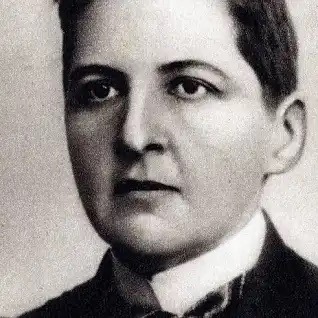
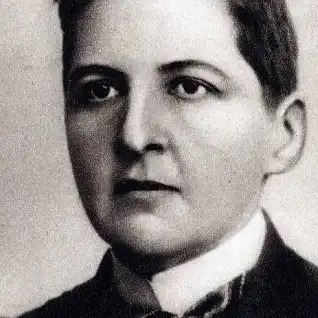
In contrast to this strategic obfuscation, the truth is plain to anyone not raised in the Polish culture of zakłamanie (systemic hypocrisy) who takes a single look at any of adult Maria’s photos; the matter is blindingly obvious. The stout, crew-cut, cigar-chomping, horseback-riding, bull-whip-yielding man in a suit and riding boots lived in sin with two women.
In fact, Rodziewiczówna’s “proclivity” was known but never spoken about. In her memoirs, R. Pachucka wrote:
At that time, I knew three pairs of women who were inseparable friends [including] Helena Weychert and Maria Rodziewiczówna. In each of these pairs, one of the women had outwardly become masculinized. [5]
Why, her sexuality was a matter of friendly joshing among her trusted friends. Boy-Żeleński staged a cabaret skit in which Rodziewiczówna was stabbed in a duel and bled holy water (comment offstage: “Ah, she was a true virgin!”).
But this well-known but embarrassing fact about a person whom we all knew and liked was not mentionable—it is not mentionable still; it would be too impolite; it would not be comme-il-faut. More importantly, such a person could never be inducted into the pantheon of national cultural heroes. Such a person had to be rejected, but the reason for her rejection could not be given, either. All one could do was pretend she wrote bad novels.
How this works is best illustrated by Jacek Bocheński in his Notes on Tiberius Caesar. His Prospectus, a delightful essay describing his visit to Capri, mentioned in a rather entertaining way a homosexual assignation:
Some will lean against the balustrade and assume expectant poses. Others, on the contrary, will stand and watch in the dark, and only their shirts will glow. These secluded vigils, feverish reconnaissances, inspections, and all this swarming in the dark will occasionally be accompanied by the flashes of lighters. And it may happen that two heads will then appear, and then two flaming zigzags and two puffs of smoke, but—after shining briefly—they will glide in opposite directions, to crawl again about the alley and fall on other fires with the flight of restless moths. But it may also happen that they suddenly strike up and—float away together and disappear into the black depths of the island like two meteors.[6]
He submitted this essay for publication to an editor of a well-known literary magazine, whose homosexual proclivities were known but never mentioned:
Now I appeared at the magazine again. And here was Julian Stryjkowski returning the “Prospectus” to me, and he did not want to discuss it at all. We were friends, and so this reluctance—as if disgust—plainly showing on Julian’s face, disconcerted me greatly. Had I written something that bad? No, but one must not write like that, because these are extremely delicate matters. What matters? I could see that Julian felt painfully wounded, even personally offended by something. By what? He brushed me off. Twórczość would not print it, period. “You cannot treat subtle feelings in such a brutal manner.” I should take the text back.[7]
There you have it. The matter is shameful. It is disgusting. Worse: it is embarrassing:
The undiminished popularity of Maria Rodziewiczówna’s books is an embarrassing subject for literary critics, because it testifies to their complete ineffectiveness in the face of the elemental force of readership.[8]
In this kind of cultural milieu, a more or less openly lesbian woman could never attain the status of a classic, no matter how well she wrote or how much or how long the public has loved her.
The opinion that Rodziewiczówna is embarrassing lingers today, often among scholars and intellectuals who are not familiar with her work but have absorbed it through their academic training and have never had a reason to verify it. Regrettably, the recent changes in Polish mores are not helping Rodziewiczówna’s reception among today's opinion-shapers. For though it is gradually becoming possible to be openly gay in Poland, the natural embracer of homosexuals—the left—cannot embrace Rodziewiczówna: she was a traditional patriot, anti-Russian, possibly anti-semitic, with special reverence for outward manifestations of Roman Catholic cult as a shared religion of her people.
In Poland, Rodziewiczówna is doomed to a low opinion among the literary establishment for some time yet. Luckily, her work now appears in translation.
[1] Czesław Miłosz, Szukanie Ojczyzny, Znak, 1992, p. 16
[2] M. Rodziewiczówna, A Summer of the Forest Folk, Mondrala Press, 2022
[3] Ibid.
[4] Accessed pn 31 December 2025
[5] R. Pachucka, Pamiętniki z lat 1914– 1939, in Emilia Padoł, Rodziewicz-ówna. Gorąca dusza.
[6] Jacek Bocheński, Tiberius Caesar, Mondrala Press 2024, p. 63
[7] Jacek Bocheński, Notes on the Trilogy, Mondrala Press, in preparation
[8] ‘The Immortal Rodziewiczówna,’ Kultura no. 10, 1988